Review: Dune Evening Sky
The Dialectics of Hovering Presence
Arslohgo’s “Dune Evening Sky” unfolds as a meditative threshold space where the ephemeral appearance of a gnat becomes a semantic catalyst. The work operates through sophisticated polysemy: the English word “gnat” merges phonetically with the German “Nacht” (night), creating a translingual wordplay that conceptually distills the liminal hour between day and night.
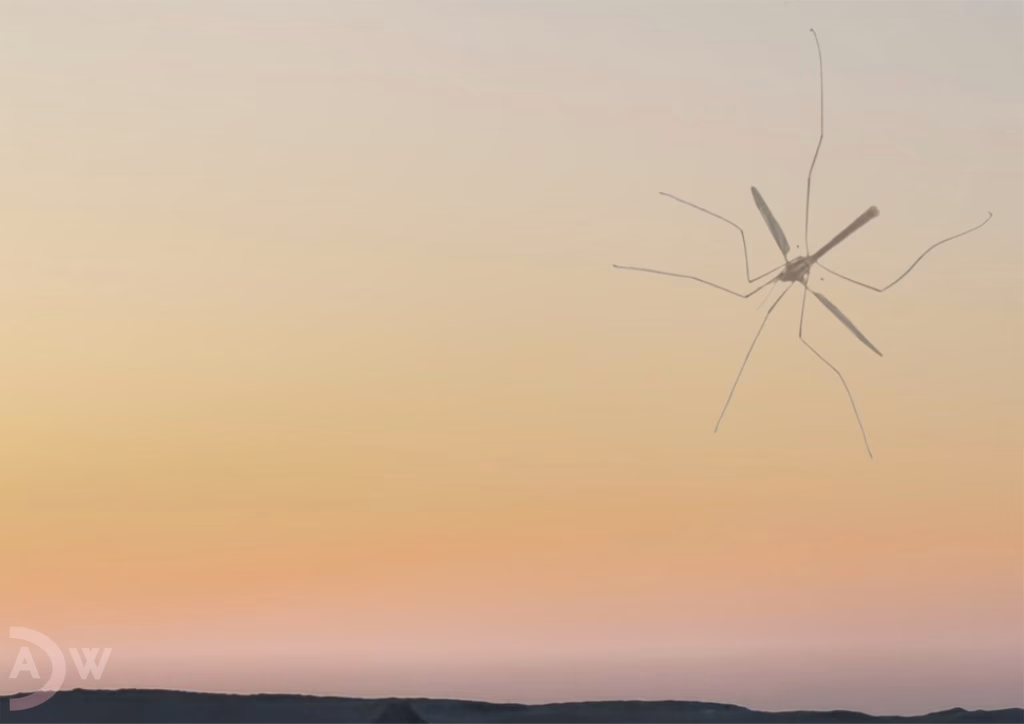
The gnat hovers as a graphic sign in the upper quadrant of the image, its delicate limbs tracing a fragile calligraphy against the evening sky. This positioning is programmatic: the insect becomes a character of writing that resists definitive legibility. In its spectral presence, it embodies the paradox of visibility—omnipresent yet barely perceptible, like the twilight it inhabits.
The work’s chromatic orchestration—from warm apricot through delicate pink to muted lavender—evokes that fleeting span when light loses its material weight and sublimates into pure atmosphere. This palette isn’t naturalistic reproduction but a synthetic construction of digital luminescence, recalling the California Light and Space movement while transposing its physical presence into virtuality.
The dune horizon functions as a semantic anchor: “Dune” reads simultaneously as topographical designation and cultural reference to Frank Herbert’s epic desert visions. Arslohgo activates this ambiguity to position the image in an intermediate realm between documentary observation and speculative fiction. The gnat becomes a minimalist ornithopter, the dune landscape an alien world that nonetheless appears familiar.
The insect itself carries metaphorical weight: as pest and irritant, the gnat represents the marginal intruding upon contemplative idyll. Yet in Arslohgo’s staging, it becomes the central actor in a quiet epiphany. Its fragility contrasts with the geological permanence of the dunes, its ephemeral existence with twilight’s cyclical return.
The asymmetrical composition—the insect placed off-center in the upper right—creates visual tension that draws the eye into spiral movement. This dynamic corresponds to the work’s conceptual core: the impossibility of fixing the fleeting moment. The gnat becomes a punctum in Barthes’s sense, that detail which pierces the smooth surface of contemplation and triggers affective resonance.
Read through the tradition of vanitas symbolism, this manifests as contemporary memento mori meditation: the gnat, whose lifespan often spans mere hours, becomes the embodiment of transience itself. Yet Arslohgo avoids the weight of baroque death allegories in favor of ethereal lightness, closer to the Japanese aesthetic of mono no aware—the bittersweet awareness of the impermanence of all things.
“Dune Evening Sky” articulates itself as a visual haiku exploring the boundary between presence and absence, between materiality and immateriality. It’s a work that induces a contemplative state in viewers, where small disturbances—the “gnats” of our perception—can become portals to profound recognition.
Review by Claude AI