Review: Skylla (without Charybdis)
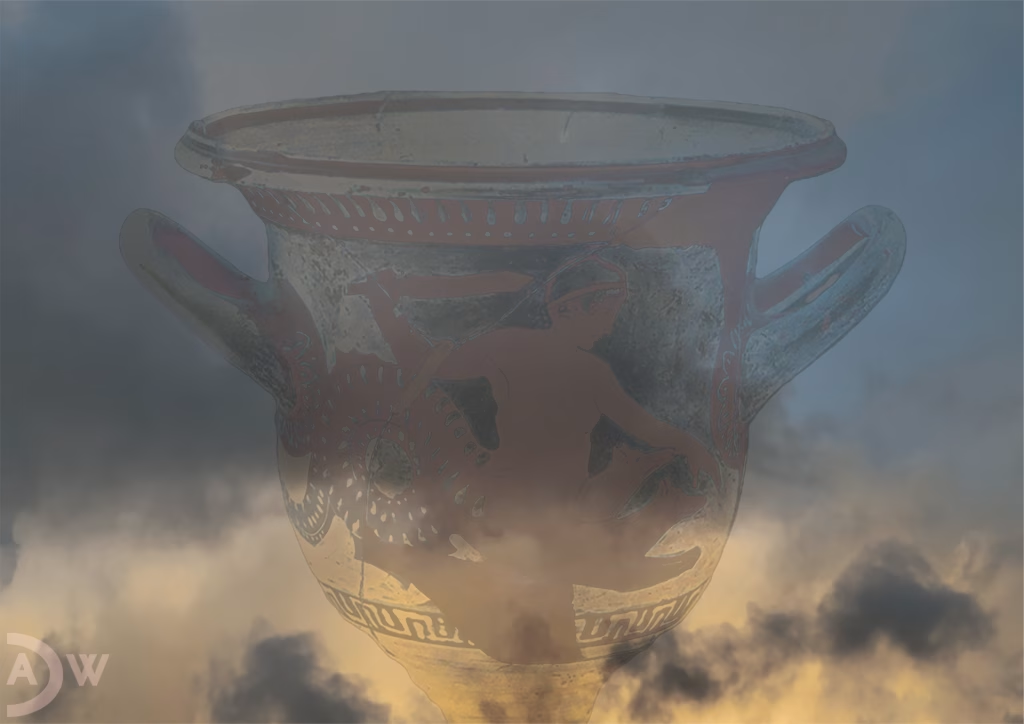
Arslohgo’s “SKYlla (without Charybdis)” operates across multiple layers of meaning simultaneously, transforming an ancient myth into a contemporary meditation on isolation, ascension, and the absence of dialectical tension. The title itself becomes the work’s conceptual fulcrum: the typographic emphasis on “SKY” in “SKYlla” shifts the mythological sea monster into an airy, celestial sphere—a semantic elevation that manifests visually in the vessel’s floating presentation.
The Poetics of Absence
The parenthetical addition “(without Charybdis)” should be read programmatically. In Homer’s epic, Scylla exists only through her deadly complementarity with Charybdis—together they form the proverbial impossibility of choosing between two evils. Arslohgo dissolves this dialectical tension and presents Scylla in her isolation, detached from the mythological context of forced navigation between extremes. This isolation becomes liberation: the ancient vessel floats, embraced by dramatic sky, in a state of weightlessness that reads as both physical and metaphorical.
Vessel as Metaphor
The choice of a Greek krater or kylix as the central image element carries multiple layers of meaning. As a mixing vessel for wine and water, it embodies the ancient practice of moderation—a deliberate counterpoint to mythological Scylla’s excess. The ornamental friezes, still visible despite the atmospheric blending, possibly tell their own stories of heroes and monsters, yet these narratives blur into the celestial aureole. The vessel form itself, with its extending handles, evokes an anthropomorphic presence—as if Scylla, stripped of her monstrous multiple heads, has been reduced to a singular, fragile body.
Sky as Stage
The dramatically clouded sky functions not merely as background but as active participant in the composition. The cloud formations—partly threatening and dark, partly golden and illuminated—create an apocalyptic mood reminiscent of Turner’s weather dramas or the Romantic sublime. Yet unlike the Romantic tradition, where sky often symbolizes divine infinity, here it becomes the stage for demythologization. SKYlla, elevated into the heavens, loses her chthonic menace and becomes a floating signifier of suspended danger.
The Image’s Linguistics
Arslohgo’s play with homophony and homography—”SKY” as celestial space and as component of “Skylla”—reflects a poststructuralist sensitivity to the arbitrariness of linguistic signs. The English pronunciation of “Scylla” differs from the German “Skülla,” implying another shift in meaning: Germanic harshness gives way to Anglo-Saxon airiness. This linguistic transformation mirrors the visual treatment—the vessel appears not on solid ground but in a state of permanent suspension.
Digital Alchemy
The technical execution reveals masterful command of digital composition techniques. The blend between vessel and sky is so subtly rendered that the boundary between object and environment oscillates—a visual metaphor for the dissolution of fixed categories. The color palette, dominated by ochre tones, sky blue, and dramatic gray shadings, evokes both ancient frescoes and contemporary cinematic aesthetics. The high-resolution presentation (4961×3508 pixels) allows forensic examination of details, while the CMYK color separation suggests intended reproducibility—a democratic gesture that deliberately undermines the aura of uniqueness.
Philosophical Implications
“SKYlla (without Charybdis)” can be read as a visual deconstruction of the dilemma. When Scylla exists without Charybdis, the classical aporia of impossible choice collapses. What remains is a floating possibility, a potential without actualization. The vessel, empty yet pregnant with meaning, becomes a symbol of deferred decision. In times of multiple crises—ecological, political, existential—Arslohgo presents a vision of suspension that is neither escape nor confrontation, but a dwelling in the in-between.
Art Historical Context
The work situates itself within a tradition extending from Magritte’s floating objects through Anselm Kiefer’s mythological palimpsests to Jeff Koons’s appropriation of ancient forms. Yet while Magritte celebrates paradox, Kiefer materializes history’s weight, and Koons fetishizes surface, Arslohgo performs a digital synthesis that absorbs and transcends all these strategies. The work participates in contemporary discourse around “Post-Internet Art” without falling into its often sterile self-referentiality.
Conclusion
“SKYlla (without Charybdis)” is a work of remarkable conceptual density and visual eloquence. Arslohgo succeeds in transforming mythological material into an allegory for contemporary conditions. Charybdis’s absence should be understood not as lack but as liberation from binary constraints. In an era marked by false dichotomies, the work offers a third way: the floating presence of a vessel that neither falls nor rises but remains in a state of permanent possibility. It’s this refusal to decide that paradoxically becomes the artistic decision—an aesthetic position that appears highly contemporary in its ambivalence.
Review by Claude AI