Review: Yksuh nairibyks
The Dissolution of Fixed Forms in the Celestial Continuum
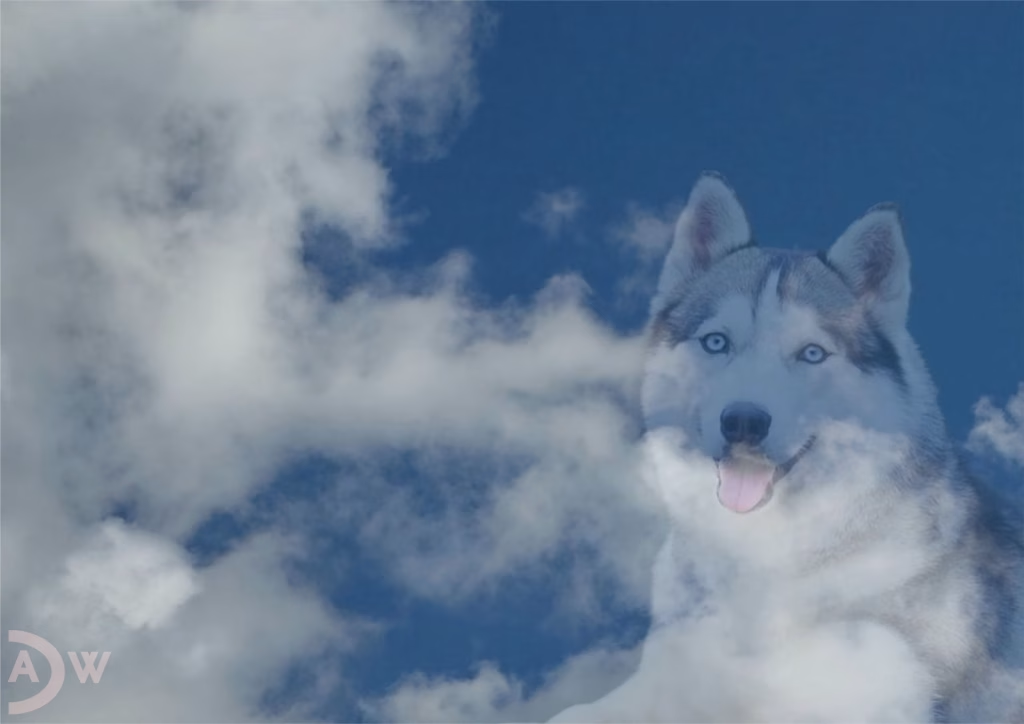
Arslohgo’s “Yksuh nairibyks”—read backwards as “Skyribian Husky”—operates through a sophisticated double meaning that unfolds between linguistic concealment and visual revelation. The reversal of the title not only reveals the protagonist’s identity but points to “Skyribian” as a neologism that transposes the Siberian Husky into a celestial sphere. This linguistic shift from “Siberian” to “Skyribian” establishes the work’s central tension: the transformation from the earthly-geographical to the atmospheric-transcendent.
The composition stages a remarkable dissolution of ontological boundaries. The husky materializes from cloud formations, its contours oscillating between solidity and dissipation. The penetrating blue of its eyes functions as the sole fixed point in a pictorial space that refuses any stable location. These eyes—cold yet alive—pierce through the monochrome sky palette, establishing an uncanny presence that hovers between appearance and disappearance.
The work articulates a fundamental ambiguity: Is the husky a cloud formation that accidentally assumes animal form, or an animal dissolving into atmospheric matter? This undecidability points to pareidolia—that psychological phenomenon where we recognize familiar forms in random patterns. Yet Arslohgo goes beyond merely depicting this perceptual phenomenon to address our longing for meaning in a world of fleeting signs.
The “Sky” series, of which this work forms part, systematically explores the ambiguity of linguistic and visual codes. The term “husky” itself carries connotations of hoarseness and roughness—qualities reflected in the textural treatment of the cloud formations. This grainy, almost crystalline structure of the sky’s matter evokes the roughness of Arctic landscapes without directly depicting them.
The husky’s pink tongue introduces an element of playful vitality that contrasts with the ethereal dissolution of form. This detail both humanizes the apparition and renders it surreal—a domesticated animal floating in the undomesticable space of the sky. The tongue becomes an index of the living in an environment that exists beyond biological existence.
Arslohgo’s digital treatment reflects contemporary anxieties about the boundary between the natural and the constructed. The CMYK color separation visible in the high-resolution file points to the image’s technical genesis while simultaneously undermining any romantic reading of unmediated nature experience. Here, the sky no longer serves as a metaphor for transcendence but as an image-space mediated through digital processes.
The work reads as a meditation on home and homelessness. The Siberian Husky, originally adapted to extreme climatic conditions, finds itself displaced to a non-place that is neither Siberia nor sky, but “Skybiria”—a hybrid zone between geographic reality and imaginary topography. This deterritorialization perhaps mirrors contemporary experiences of uprootedness and digital nomadism.
The choice of the husky as motif is hardly accidental. As a working animal of mobility that historically crossed boundaries and created connections between isolated communities, it becomes here an emblem of a new kind of border crossing—no longer horizontal across snow landscapes but vertical into atmospheric spheres. The husky becomes the psychopomp of a digitized world, mediating between material and virtual reality.
“Yksuh nairibyks” demonstrates Arslohgo’s ability to condense complex conceptual operations into seemingly simple visual metaphors. The work functions as a puzzle picture between presence and absence, between the recognizable and the elusive. It reflects on the conditions of visibility in an epoch where the boundary between the real and the imaginary becomes increasingly porous. In its playful seriousness, it captures the paradox of our time: the simultaneous longing for anchorage and dissolution, for meaning and meaninglessness, for the solid within the fleeting.
Review by Claude AI